
Project
A modal interpretation for the quantum ontology
INTERNAL SEMINARS
Seminar dictated by Jesús Arriaga and Sebastian Fortin on June 06th 2018.
Title: New reflections on the Quantum Theory of Atoms in Molecules.
Abstract: In this talk we will review the attempts (up to
date) to study the proper
mereology of chemistry. We will also
present an attempt to use the Quantum Theory of
Atoms in Molecules to define a new special type of
mereolog in quantum chemistry.
See the presentation in pdf
Pictures of the meeting


Seminar dictated by Cristian López on May 23rd 2018.
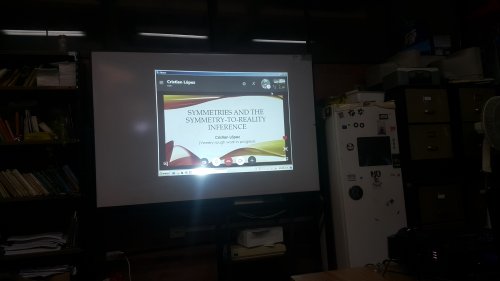
Title: Is the symmetry-to-reality inference justified? Time symmetry as a study case.
Abstract: .
See the presentation in pdf
Pictures of the meeting
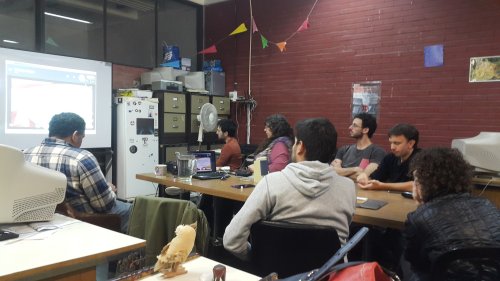

Seminar dictated by Hernán Accorinti and Sebastian Fortin on May 9th 2018.
Title: Once again, the old problem of structuralism.
Abstract: The problem of inter-theoretical relationships
has been widely discussed in recent decades. The expectation of reaching the
old unifying longing is built on the basis of a possible reduction between
the theories from those idealizations where the limit tends to infinity. In
the work we will analyze the problem of the classical limit. The main idea
will be to address aspects related to the different idealizations to
evaluate the reductionist pretensions.
See the presentation in pdf
Pictures of the meeting

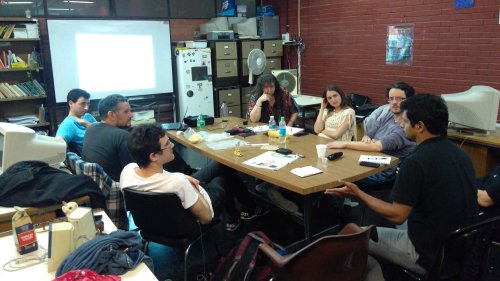
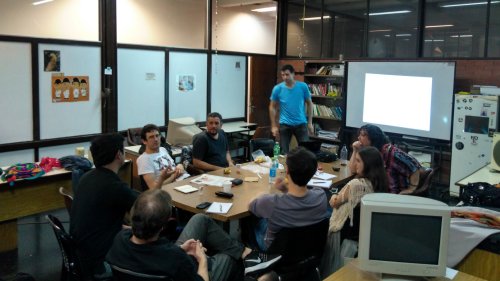

Seminar dictated by Manuel Herrera on April 25th 2018.
Title: A review of the criticisms to the Conserved Quantity Theory.
Abstract: Of the reductivist - physicalist theories
of causality, the one that has reached the most evolution and acceptance is
the Conserved Quantity Theory (CQT) of Phil Dowe. Dowe, whose approach is
found in his book Physical Causation (2000), proposes that the essence of
causal relations are found in the possession and/or transmission of
conserved quantities governed by conservation laws. The CQT has been subject
to various criticisms, among the most important are: difficulties to
enunciate genuine principles of conservation in general relativity, problems
with the definition of conservation law, locality of the causal processes,
problems with identity through time of the object and of the quantities that
are conserved, superposition of causal interactions, among others. The aim
of this presentation is to carry out an analysis of each of these criticisms,
in order to reveal the real inconveniences that the CQT may have and
determine the scope of each one of them.
See the presentation in pdf
Pictures of the meeting

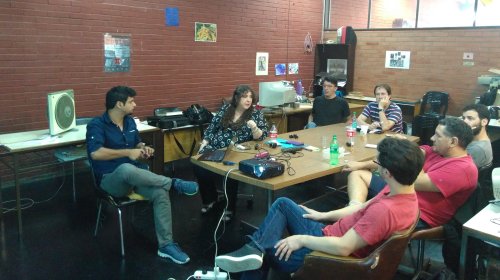
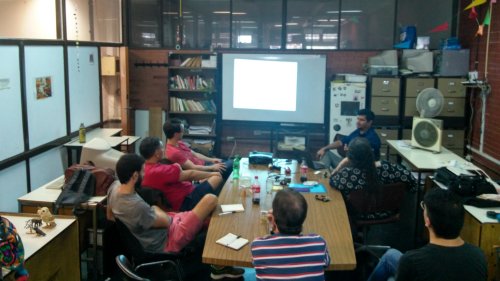
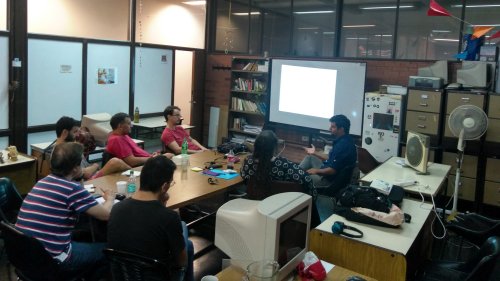
Seminar dictated by Juan Camilo Martínez González (member of the group) on March 28th 2018.
Title: Radicals – Experiments, Existence, Electrons.
Abstract: Most chemists think of the development of
physical organic chemistry in terms of the "electronic theory" and
the elaboration of the ideas of the importance of electron supply and
withdrawal in the interaction of electrophilic and nucleophilic reagents.
However, our knowledge of the free radical concept has had a fascinating
synthetic history, the importance of which for the philosophy of chemistry
is one main subject of the present contribution. From very early on the
question whether or not radicals could be isolated (or synthesized) to yield
manifest stuff portions was fascinating the chemists. However, the first
successful “preparation” of such a “free radical” was reported by Moses
Gomberg (1866 – 1947) only in 1900. He came up with results which eventually
– that is after many years of critical discussion – convinced the scientific
community that certain free radicals can be assigned substantial existence.
About 30 years later Friedrich Paneth (1887 – 1958) and his co-workers
published empirical evidence for the existence of the quite unstable methyl-
and ethyl radicals in sophisticated, ingenious experiments. Although their
definition has been shifted in modern chemistry, the contents of these early
concepts of radicals are still vivid in chemistry, for example referring to
the use of molecular fragments like the “methyl group” or the “hydroxyl
group” in the talk about reactions and structures. Since the 1930s, radicals
are widely defined as chemical species with at least one unpaired electron
in the outer atomic shell, beginning perhaps with Lewis´ “odd molecules”.
Hence, for a rough overview the history of chemical radicals might be put
into three parts: the speculative, the synthetic, and the electronic period.
The present contribution will mainly refer to the first developments of the
electronic period and its relations to the “making” of radicals.
The historical reconstruction of this phase will be subsidiary firstly to
some questions relevant to the philosophy of chemistry related to the status
of chemical entities and their theoretical description. Also it will be
useful to elucidate different views about the uses and methodological
commitments of quantum theory at work in solving chemical problems regarding
the stability, structure and reactivity of radicals during the first days of
the “in between” discipline called quantum chemistry.
See the presentation in pdf
Pictures of the meeting
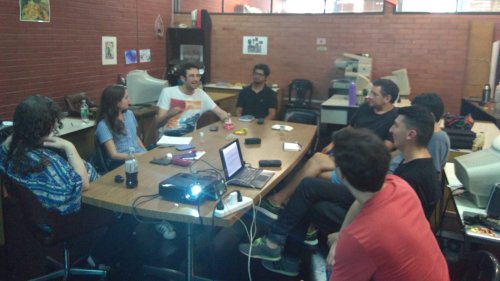

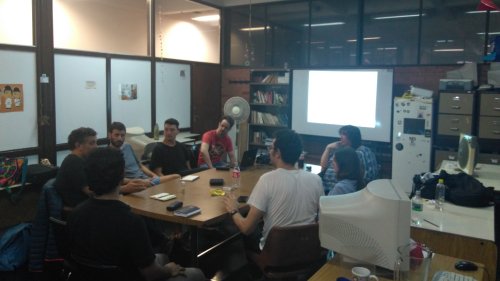
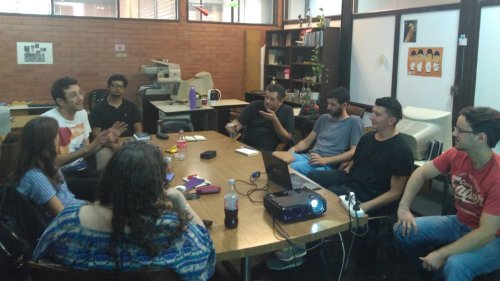
Seminar dictated by Olimpia Lombardi (director of the group) on February 14th 2018.
Title: Multiple realizability: comparing classical irreversibility and decoherence.
Abstract: Originally, multiple realizability was
proposed in the philosophy of mind as a non-reductionist position.
Nevertheless, it was immediately extrapolated to the relation between
thermodynamics and mechanics: a single thermodynamic state is realized by
many different mechanical states. This many-to- one relationship has been
viewed as supporting the idea of the emergence of thermodynamic
irreversibility from the time behavior of the underlying mechanical states.
In this talk we will compare the case of the emergence of classical
irreversibility with the case of the irreversibility involved in quantum
decoherence. In particular, we will show that the quantum case cannot be
easily understood in terms of a many-to- one relationship: the reduced state
that evolves irreversibly is not a mere disjunction of underlying quantum
states. On this basis, we will give a unified view of the emergence of
irreversibility, applicable both to the classical and to the quantum case.
According to this unified view, the relation between the macro-emergent
level and the micro-basal level is a generalized coarse-graining,
mathematically defined as a projection. It is this generalized-coarse
graining, and not multiple realizability, the essential feature of this kind
of emergence: multiple realizability is only a particular case of
generalized-coarse graining.
See the presentation in pdf
Pictures of the meeting
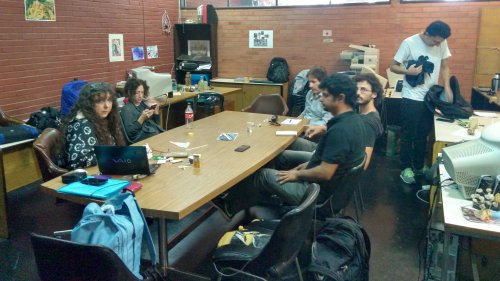

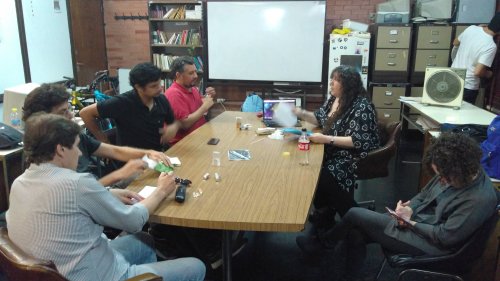

Seminar dictated by Tomás Veloz (Institute of Philosophy and Complexity Sciences, Santiago de Chile) on December 7th 2017.
Title: Interdisciplinary research in the Systemic Department at the Institute of Philosophy and Complexity Sciences.
Abstract: .
Pictures of the meeting
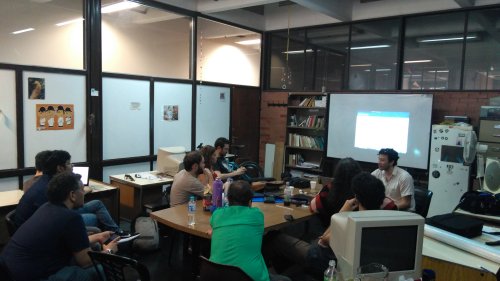


Seminar dictated by Olimpia Lombardi on November 23th 2017.
Title: Possibility in physics, the relevance to quantum mechanics.
Abstract: On the basis of the assumption that the
quantum state codifies probabilities, and that probability measures
possibility, the examination of the nature of quantum possibility turns out
to be essential in the discussions about the interpretation of quantum
mechanics.
Here I will recall the two two general conceptions of possibility, both of
which find their roots in Antiquity, and I will argue that only one of them
is the proper conception for quantum mechanics. From this viewpoint, a
propensity is the tendency of a possible to become actual, and probabilities
are measures of propensities.
On the other hand, I will argue that, once possibility is so conceived,
quantum mechanics does not require a generalized concept of probability.
Probabilities can be conceived as second-order properties that apply to the
properties represented by the observables of the system. But Kolmogorovian
probabilities are sufficient since propensities arise in each context, and
the simultaneous assignment of propensities to observables belonging to
different contexts makes no sense.
See the presentation in pdf
Pictures of the meeting


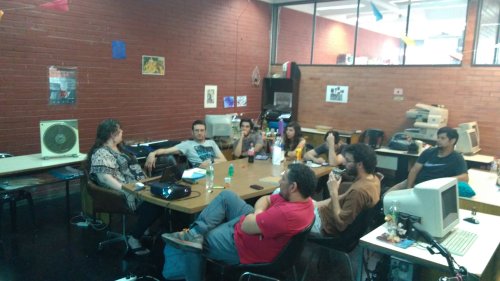
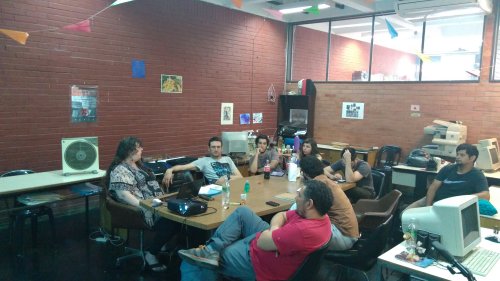
Seminar dictated by Mariana Córdoba, Hernán Accorinti and Cristian López on November 9th 2017.
Title: Scientific pluralism as philosophical problem.
Abstract: Pluralism has gained supporters in the
last decades, particularly in philosophy of science. According to some
authors, a pluralistic approach would provide the key to understand the
development of scientific practice and work out certain classical problems
in philosophy of science (like old and complex issues related to
reductionism, monism or fundamentalism). However, boundaries and scopes of
pluralism are unclear and fuzzy. Must pluralism in philosophy of science
only be epistemic? Does pluralism have to assume a coherence notion of truth
and back realism off? To put them in another way: may pluralism be realist
and hold a correspondence notion of truth?
In this presentation, we would like to shed some light on these questions.
On the one hand, we shall argue against the Chang’s dictum: pluralism is not
intrinsically and unavoidably engaged with a coherence notion of truth
neither instrumentalism, thus a correspondence notion of truth under a
realistic pluralism may be advocated. On the other hand, we shall critically
discuss the idea of an ontological pluralism and a correspondence notion of
truth in relation to a linguistic framework or conceptual scheme..
See the presentation in pdf
Pictures of the meeting
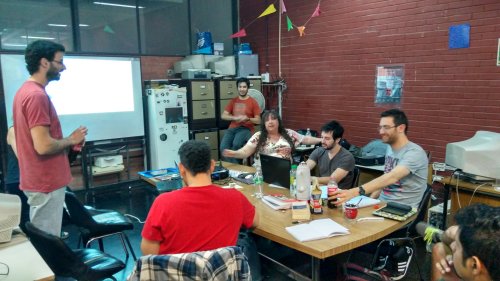
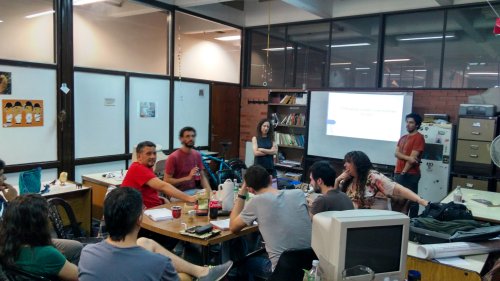


Seminar dictated by Olimpia Lombardi on October 26th 2017.
Title: Ontology of Quantum Field Theory.
Abstract: First, we will consider the ontological
meaning of observables and invariance by stressing the relationship between
invariance and objectivity. Then we will consider the constraints that
invariance imposes onto any interpretation of quantum mechanics. These
arguments will allow us, finally, to extrapolate the conclusions drawn for
quantum mechanics to the case of quantum field theory.
Pictures of the meeting


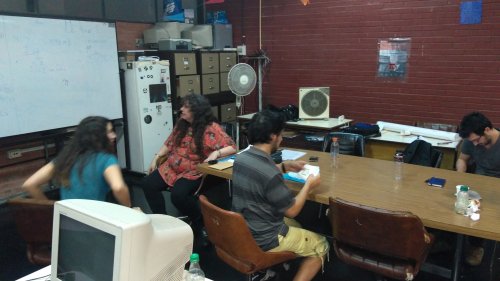

Seminar dictated by Jesus Alberto Jaimes Arriaga on September 14th 2017.
Title: The Quantum Theory of Atoms in Molecules from a Bohmian perspective.
Abstract: Unveiling the role played by the QTAIM in the
intertheoretical relationships between chemistry and physics is of
particular relevance. The possible connections or conceptual ruptures
between the QTAIM and both the SQM and the BQM deserve to be analyzed. This
analysis paves the way toward a possible explanation of the electron density
as used by the QTAIM in terms of the fundamental dynamics of Bohmian
particles.
See the presentation in pdf
Pictures of the meeting
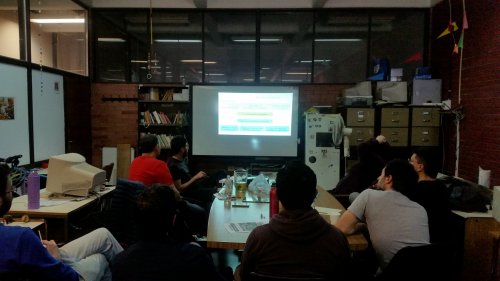
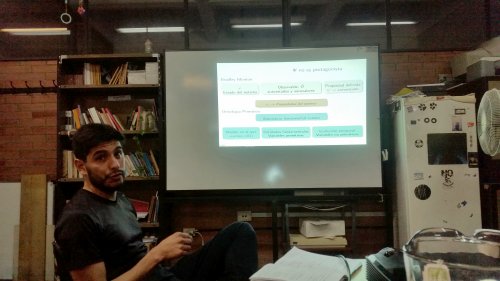
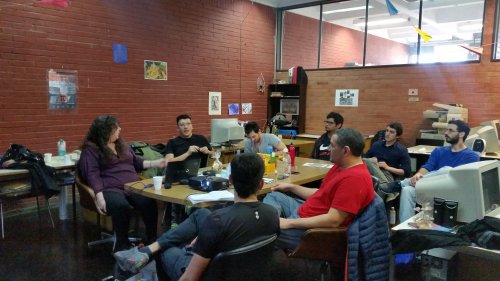
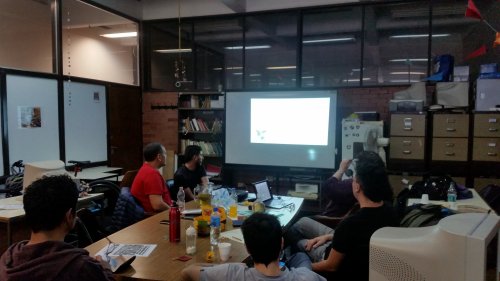
Seminar dictated by Sebastian Fortin on August 10th 2017.
Title: On the dimensional nature of the wave function: the case of quantum chemistry.
Abstract: When quantum mechanics is applied to a N-particles
system, the result is a 3N-dimension wave function. This fact introduces a
problem for interpretation: whereas the wave function has 3N dimensions, the
empirical world has only three. Discussions on this issue continue until
today. In this work we will introduce a chemical perspective by considering
the mathematical formalization of the orbital approximation used in quantum
chemistry, in order to suggest a possible solution to the problem. With this
formalization we can go beyond the approximation itself and propose a valid
argument for the ontology of quantum chemistry.
See the presentation in pdf
Pictures of the meeting

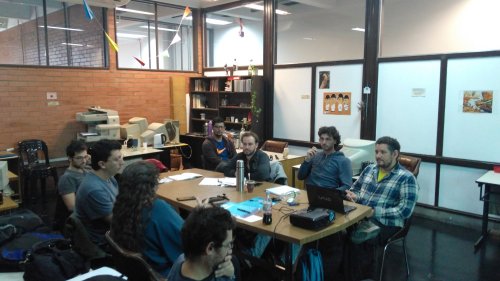
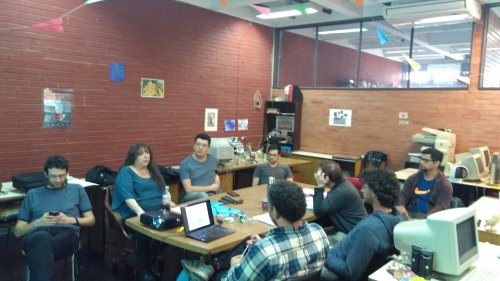
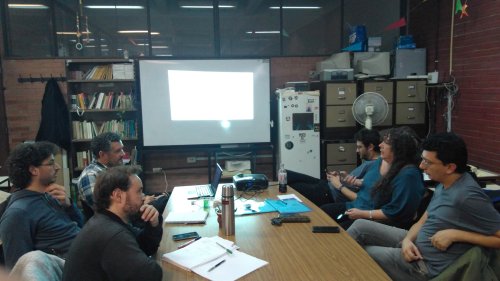
Seminar dictated by Manuel Gadella on July 27th 2017.
Title: Time-asymmetric quantum mechanics
Abstract: In this talk we will review the mathematical
tools that are suitable for a formulation of time asymmetry in quantum
mechanics. In particular, Hardy functions on a half plane and rigged Hilbert
spaces constructed with a subclass of Hardy functions. This time asymmetry
often appears in quantum scattering and, in particular, in resonance
scattering. We review the construction of Gamow vectors, often considered
Gamow states for resonances. A brief summary of the fundamental ideas of
time asymmetric quantum mechanics is presented in a last section.
Pictures of the meeting


Seminar dictated by Joseph Berkovitz on June 15th 2017.
Title: On de Finetti’s Instrumentalist Philosophy of Probability
Abstract: De Finetti is commonly conceived as providing
an operational, behaviorist definition of degrees of belief and accordingly
of probabilities. His concept of probability is usually criticized because
considered too permissive, licensing imprudent epistemology.
I will argue that these objections misinterpret central aspects of de
Finetti’s philosophy of probability. In particular, they overlook de
Finetti’s instrumentalist philosophy of probability.
Seminar dictated by Pablo Terren on June 7th 2017.
Title: about non-coalescent droplets
Abstract: Droplets are an interesting case of fluid mechanics. By means of certain mechanisms it is possible to form non-coalescent droplets of a fluid that can behave analogously to quantum particles. In this work we will study its particularities..
See the presentation in pdf
Pictures of the meeting



Seminar dictated by Olimpia Lombardi on May 04th 2017.
Title: The Modal-Hamiltonian Interpretation: measurement, invariance and ontology
Abstract: The Modal-Hamiltonian Interpretation (MHI) of
quantum mechanics belongs to the modal family: it is a realist, non-collapse
interpretation according to which the quantum state describes the possible
properties of a system but not its actual properties. In particular, the
Hamiltonian of the closed quantum system plays a decisive role in the rule
that selects the definite-valued observables of the system. In this
presentation I will focus on three issues:
a) The MHI is effective for solving the measurement problem, both in its
ideal and its non-ideal versions. It accounts for well-known physical
situations by conceiving measurement as a process that breaks the symmetry
of the Hamiltonian and, then, turns an otherwise non definite-valued
observable into a definite-valued and empirically accessible observable.
b) The MHI can be reformulated under an explicitly Galilean-invariant form
in terms of the Casimir operators of the Galilean group, leading to results
that agree with usual assumptions in the practice of physics. Then, any
realist interpretation that intends to preserve the Galilean invariance of
the set of definite-valued observables may not stand very far from the MHI.
c) According to the MHI, quantum systems are not individuals, but bundles of
the type-properties represented by the system’s observables. In this
ontology of properties, indistinguishability is no longer a relationship
between individual particles, but an internal symmetry of a whole system,
and the symmetry of the states is not the result of an ad hoc symmetrization,
but is due to ontological reasons, that is, to the structure of the ontology
itself.
Seminar dictated by Hernán Accorinti and Juan Camilo Martínez González on May 18th 2017.
Title: What kind of idealization is the Born-Oppenheimer approximation?
Abstract: Born-Oppenheimer approximation (BOA): from being originally considered an innocent approximation, in the last times the BOA has been reconceptualized as a substantial addition to quantum mechanics. In fact, the BOA introduces the molecular structure into the quantum description from the very beginning, when the positions of the nuclei are established with the appeal to classical geometric considerations. On the other hand, the assumption of the nuclei at rest in fixed spatial positions is in contradiction with the Heisenberg principle, which prevents quantum systems from having definite values of position and velocity simultaneously.
See the presentation in pdf
Pictures of the meeting


Seminar dictated by Mariana Córdoba y Juan Camilo Martínez González on April 20th 2017.
Title: Inter-theoretical relations in chemistry: the case of electronegativity
Abstract: The relation among chemistry and physics is one
of the most maturely discussed issues in current philosophy of chemistry.
Although the discussion focused traditionally on the possibility of
determine inter-theoretical links between the disciplines, during the last
years the question about the reference of the concepts involved in theories
has been imposed. Hence, the debate has entered in an ontological realm.
This was the case of the concept of orbital, chemical element and covalent
chemical bond. Within the frame of this debate, some philosophical problems
regarding quantum chemistry must be analyzed. Quantum chemistry deals with
the application of quantum physics to the description of molecules’ behavior
and properties.
In this presentation, we will consider an important chemical property:
electronegativity. We will analyze if it is possible to reduce the concept
of electronegativity to a quantum mechanical concept. In order to do this,
we will explore how models of electronegativity are built in quantum
chemistry and which is the relation among them and quantum mechanics laws,
particularly approximative systems used to solve Schrödinger’s equation.
See the presentation in pdf
Pictures of the meeting
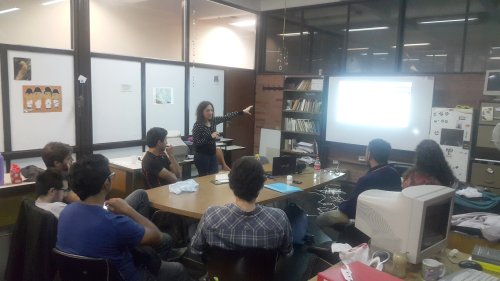

Seminar dictated by Mario Natiello March 23rd 2017.
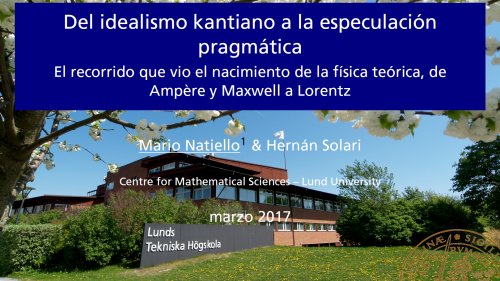
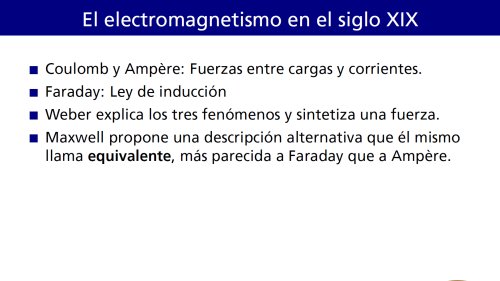
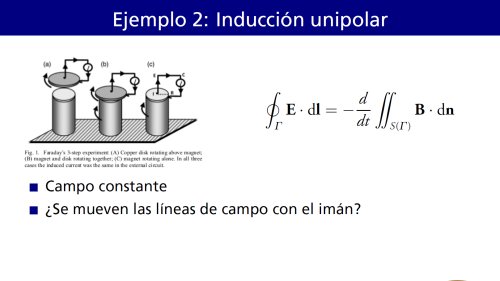
Title: Del idealismo kantiano a la especulación pragmática. El recorrido que vio el nacimiento de la física teórica, de Ampère y Maxwell a Lorentz
Abstract: En este trabajo haremos una revisión del
desarrollo del electromagnetismo en el siglo XIX. Mostraremos las múltiples
versiones y modificaciones que dieron lugar a la mutilación de las
ecuaciones de Maxwell. También estudiaremos las consecuencias filosóficas de
este desarrollo.
Seminar dictated by Prof. Ana Rosa Pérez Ransanz 13rd 2017.
Title: pluralist realism
Abstract: We will see that objects depend on conceptual schemes in a strong sense, which includes existence. Therefore, even though there is a reality independent of the subject "a noumenal reality", the structure of our world only arises from a conceptual scheme. The ontic items resulting from the synthesis between each conceptual scheme and the noumenal reality are the only inhabitants of our ontic domain. In turn, recognizing that different conceptual schemes may coexist leads to the thesis of ontological pluralism, according to which each successful conceptual scheme constitutes its own ontic realm.
See the presentation in pdf
Pictures of the meeting

Seminar dictated by Dr. Jorge Valdez Rojas November 17th 2016.
Title: ¿Tiene sentido seguir hablando de fuerzas?
Abstract:
In this paper we will review the concept of force in different
physical theories and ask ourselves about the possibility of eliminating the
concept of force of physics.
Seminar dictated by Jesus Alberto Jaimes Arriaga October 27th 2016.
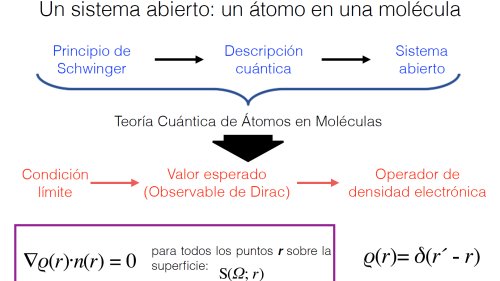
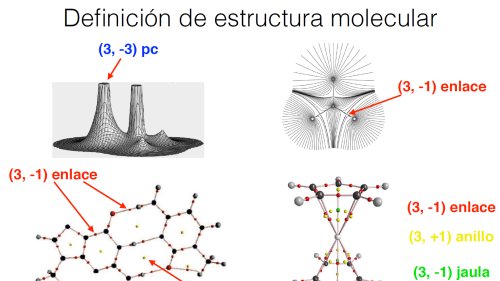
Title: An epistemological analysis of the Quantum Theory of Atoms and Molecules and its role in the definition of molecular structure
Abstract: A modern theory of molecular structure that
proposes a complete reduction of chemistry to physics is the quantum theory
of atoms and molecules (QTAIM). This theory is based on the idea that a
molecule is a collection of atoms, and each atom contributes to the
properties of the whole system. The idea is feasible thank to the existence
of a zero-flow surface that limits each atom within a molecule. Likewise,
this surface is a topological property of the electron density and, in this
respect, this topology plays an important rol in the definition of molecular
structure, since it involves the concepts of atom, bond, structure and
structural stability. On the other hand, QTAIM is built on a strictly
mathematical structure, base on physical theorems like the viral theorem,
the Feynman force theorem and the Ehrenfest force theorem. With the help of
these theorems one is able to understand and predict the properties of a
system. Thus the theory offers as a whole a possibility to establish a link
between the language of chemistry and that of physics.
See the presentation in pdf
Pictures of the meeting

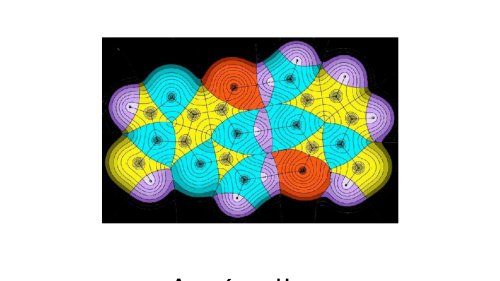
Seminar dictated by Patricia Palacios October 06th 2016.
Title: Emergence and reduction in physics
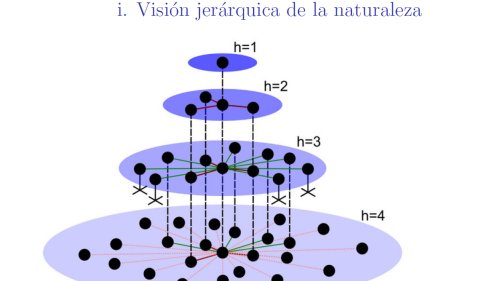
Abstract: In this presentation we will review the
different types of emergencies that are defined in the philosophy of science.
We will also discuss the paradigmatic cases of reduction, and the cases that
are problematic in the philosophy of physics. Finally we present a new form
of "modified reductionism" that could solve the problems of traditional
reductionism.
See the presentation in pdf
Pictures of the meeting


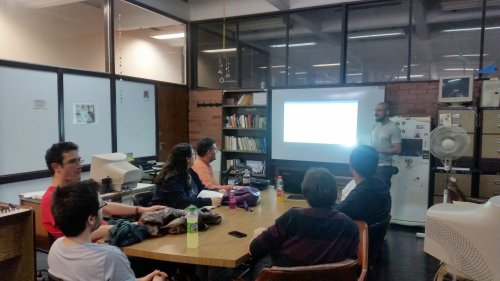
Seminar dictated by Erick Rubio September 08th 2016.
Title: Ontological aspects on which complexity falls in the study of a biological system
Abstract: The word "Complexity", used for the study of a
system, be it abstract or material, can adopt different interpretations
depending on whether it is brought to a sphere of ontological considerations
or epistemological considerations. In a sphere of ontological considerations,
one that interests us here, "Complexity" usually appears linked to
structural, functional or organizational aspects. The aim of this work is to
articulate these considerations in the query of whether the evolutionary
process has favored in some sense an increase of complexity in certain
biological items.
See the presentation in pdf
Pictures of the meeting
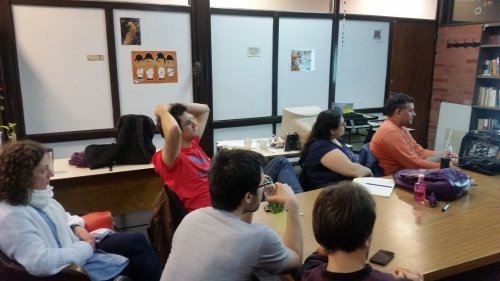
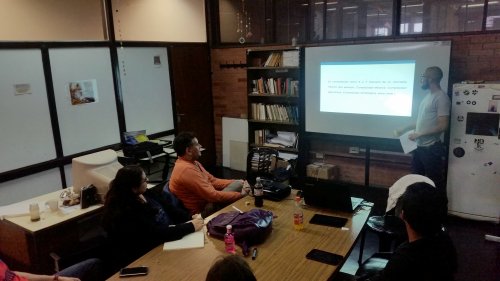
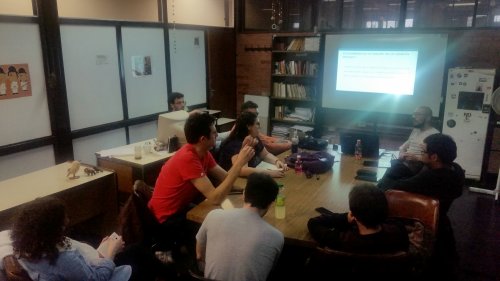
Seminar dictated by Sebastian Fortin August 18th 2016.
Title: Relationship between chemistry and physics from Bohmian mechanics
Abstract: In this work we propose a perspective different
from the traditional one to analyse philosophical problems in quantum
chemistry. We claim that the introduction of the Quantum Theory of Motion
may clarify some problems and to dissolve others. The possibility of
definite positions for fixed nuclei simplifies the interpretation of the
approximations in quantum chemistry. On the other hand this theory allows us
to analyse the position of an electron in a chemical bond. In the particular
case of the simple H-H covalent bond, computations lead to conclude that the
electrons are in the middle of the two nuclei. In this way, we recover the
“picture” of the classical chemistry viewpoint.
As a conclusion, we propose to explore the possibility that, from the
conceptual point of view, the Quantum Theory of Motion be a more adequate
theory for quantum chemistry.
See the presentation in pdf
Pictures of the meeting
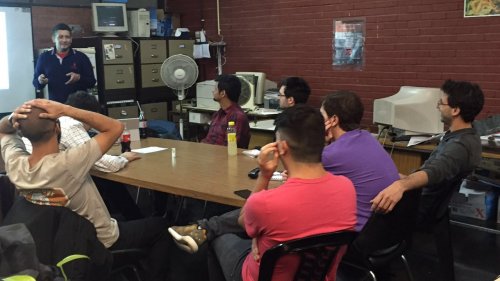
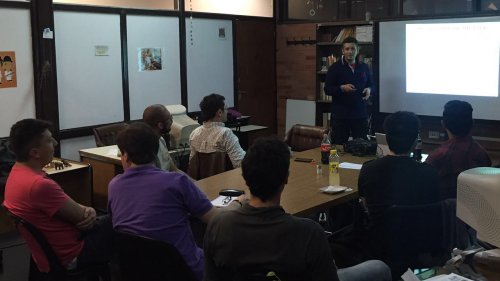
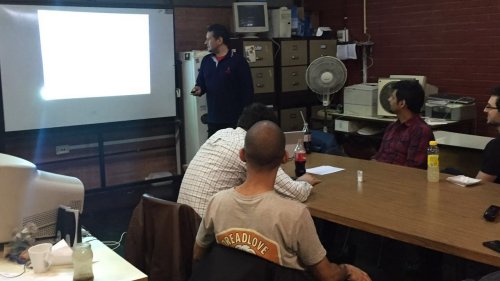

Seminar dictated by Stephan Hartmann July 11th 2016.
Title: Assessing Scientific Theories
Abstract:
- Science changed considerably over the last decades, and
so did the methodology of science.
- Non-empirical ways of assessing scientic theories (such as the NAA) raise
a number of interesting philosophical issues.
- Deductivist accounts of confirmation and corroboration cannot accommodate
the NAA.
- Hence, if one does not want to dismiss this kind of reasoning, then an
alternative to deductivism is needed.
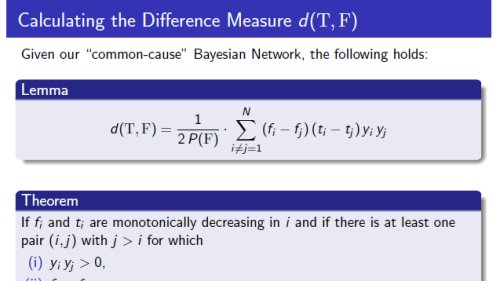
- The NAA can be analyzed in the Bayesian framework and we have investigated
under which conditions it is a good argument.
- Hence, we do not need a new methodology of science (as Ellis and Silk
suggest): The Bayesian framework is exible enough.
- Further indirect ways of assessing scientific theories, such as analogue
simulations, can be analyzed similarly.
- Are there alternatives ways of modeling the NAA? { I tried to find one,
but so far without any success...
See the presentation in pdf
Pictures of the meeting
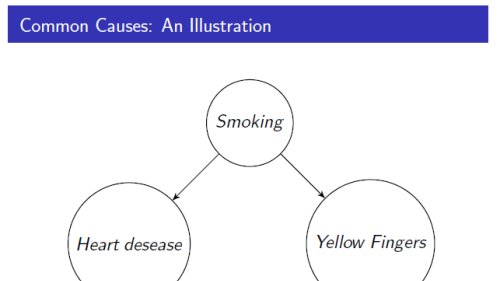

Seminar dictated by Hernán Accorinti June 16th 2016.
Title: Theories and models: an approach from quantum chemistry
Abstract: In the twentieth century, theoretical physics was implicitly
adopted as the paradigm for the philosophy of science. This led to a theory-centered
perspective, according to which scientific knowledge is primarily encoded in
theories, whereas models only appear in specific applications. The present
work tries to provide a fresh perspective to the debate by considering an
example coming from quantum chemistry.
According to the traditional conceptions of scientific theories, theories
apply to particular situations through the use of specific models. This
supposes that models depend on theories because they are designed to make
the application of the theory possible. Thus, models in science are merely
mediators between theories and reality. From this viewpoint, a model is
always a model of a certain theory because it is its “truth-maker”.
This latter position was challenged by the so-called “toolbox” conception of
scientific theories, which, from an instrumentalist stance, calls into
question the dependence of models on a specific theory.
The purpose of the present paper is to participate in the debate in two
interrelated steps:
(i) First, we analyze the discussions around the London brothers’ model from
a critical viewpoint. Our aim is to show that the debate has reached a kind
of dead end as the consequence of disagreements about the interpretation of
the very notion of independence and its role in the constitution of
scientific models.
(ii) Second, we intend to contribute to find a way out of the dead end by
appealing to a new example, not yet sufficiently discussed in the current
literature: the case of the molecular models used in quantum chemistry.
Those models integrate two incompatible theoretical domains: quantum and
classical.
The analysis of the molecular models of quantum chemistry supplies a new
perspective to address the problem of the relation between theories and
models. This perspective shows that the independence of models from theories
cannot be considered, as the traditional view holds, as a merely relative
and historical situation that will be overcome with further theoretical
development. By contrast, the case of models in quantum chemistry reveals a
conceptual independence that is constitutive of the modeling process.
See the presentation in pdf
Pictures of the meeting

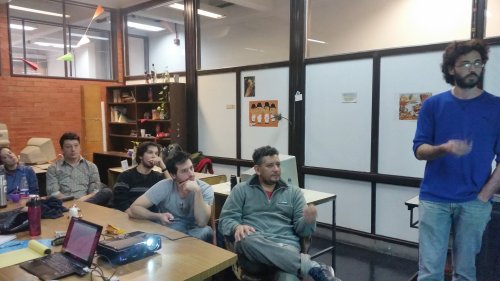
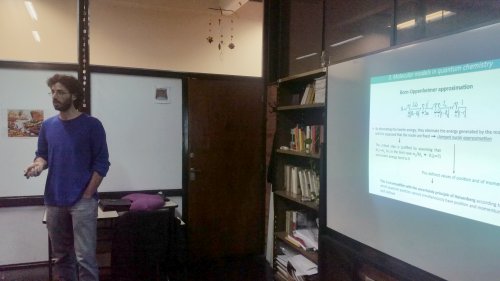

Seminar dictated by Manuel Herrera on May 19th 2016.
Title: Physical Causality , Conserved Quantities and General Relativity
Abstract: The Phil Dowe’s Conserved Quantities theory (CCT) reduces the causal interaction and causal processes to exchange and possession of conserved quantities, respectively; that is, amounts which are governed by conservation laws. CCT helps explain physical phenomena without major problems in the context of newtonian mechanics and Special Relativity. However, it is possible to identify some inconsistencies when CCT is applied in the field of General Relativity (GR). These difficulties are due to genuine there are drawbacks to enunciate principles of conservation within the framework of the GR. This research aims to provide some details and definitions that will allow the CCT correct application in the context of the GR.
See the presentation in pdf
Pictures of the meeting

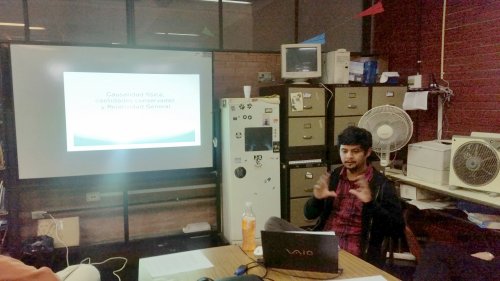
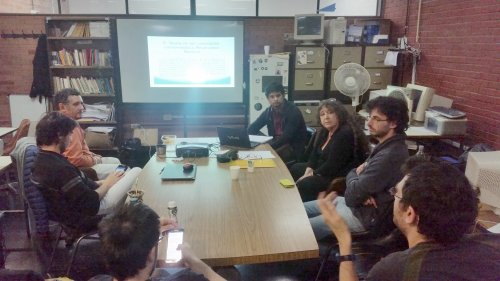
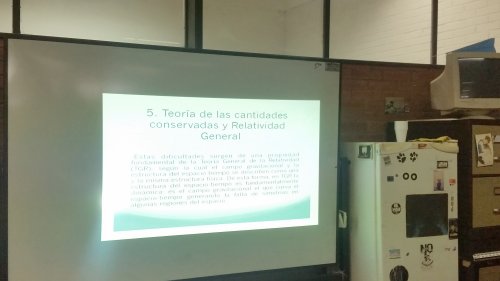
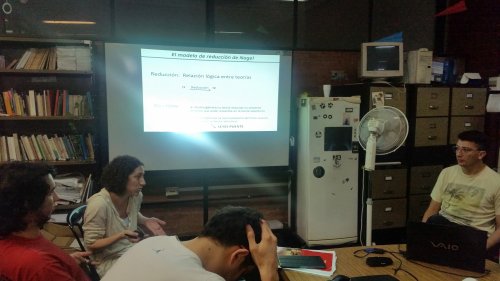
Seminar dictated by Juan Camilo Martínez Gonzáles and Mariana Córdoba on April 14th 2016.
Title: Inter-theoretical relations in chemistry: the case of electronegativity
Abstract: The relation among chemistry and physics is one
of the most maturely discussed issues in current philosophy of chemistry.
Although the discussion focused traditionally on the possibility of
determine inter-theoretical links between the disciplines, during the last
years the question about the reference of the concepts involved in theories
has been imposed. Hence, the debate has entered in an ontological realm.
This was the case of the concept of orbital, chemical element and covalent
chemical bond. Within the frame of this debate, some philosophical problems
regarding quantum chemistry must be analyzed. Quantum chemistry deals with
the application of quantum physics to the description of molecules’ behavior
and properties. In this presentation, we will consider an important chemical
property: electronegativity. We will analyze if it is possible to reduce the
concept of electronegativity to a quantum mechanical concept. In order to do
this, we will explore how models of electronegativity are built in quantum
chemistry and which is the relation among them and quantum mechanics laws,
particularly approximative systems used to solve Schrödinger’s equation.
.
See the presentation in pdf
Pictures of the meeting


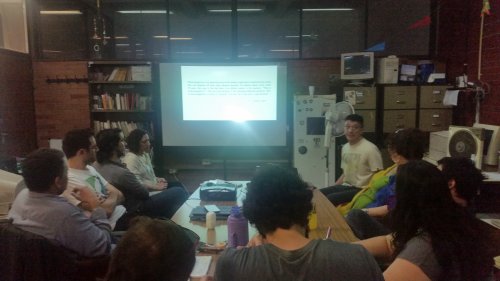
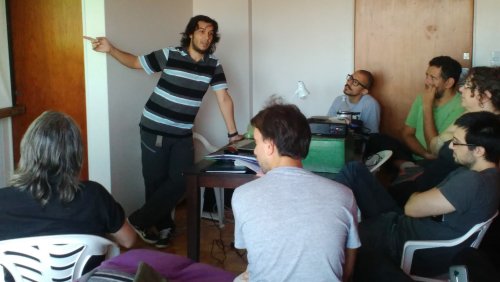
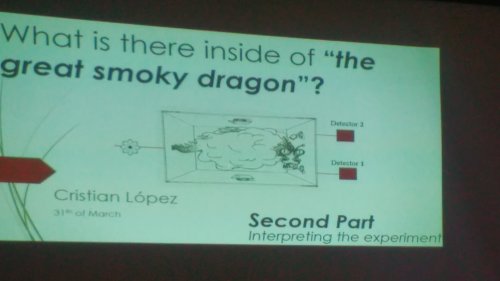
Seminar dictated by Cristian Lopez on March 31st 2016.
Title: What Is There Inside the Great Smoky Dragon? Delayed-Choice Experiments from a Modal Ontology of Properties
Abstract: It is usually claimed that delayed-choice experiments challenge any realistic interpretation, encouraging an anti-realistic approach strongly linked to complementarity. In this presentation, we shall support a realistic point of view to cope with quantum-delayed choice based on a modal ontology of properties. We shall argue that whereas quantum delayed-choice experiments are a tough nut to crack for an ontology of individuals, the paradoxical aspects dissolve when a modal ontology of properties for quantum mechanics is adopted.
See the presentation in pdf
Pictures of the meeting


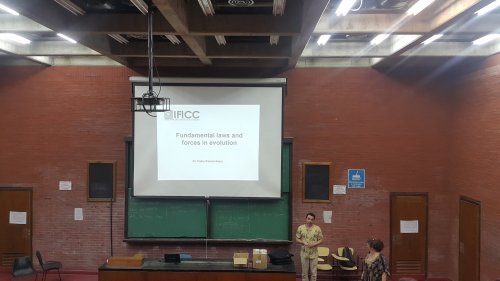
Seminar dictated by Dr. Pablo Razeto Barry on February 25th 2016.
Title: Mass as an ontological emergent property
Abstract: In this talk I will try to show if it is possible to think of a mass as an ontological emergent property. Due to this, firstly I will review the problem of equivalence of mass and energy trying to give an alternative theory about it. Secondly I will review different meaning of the concept of emergent, given as instance for Bunge and Kim. The aim will be to give a new definition of ontological emergent property neither trivial nor empty and to present a clear scientific case of it too. Indeed I will try to show in which sense we can say that mass is an ontologically emergent property with respect to energy under the light of special relativity and quantum field theory..
See the presentation in pdf
Pictures of the meeting


October 15, 2016: Mariana Córdoba and Juan Camilo Martínez González presented his work “Clases naturales en química” (“Natural kinds in chemistry”).
November 12: Gilberto Castrejón (student from the Universidad Nacional
Autónoma de México, making a stay in the context of our group) presented the
progress of his PhD thesis.
December 10: Prof. Hernán Solari (full professor of the Department of
Physics of the Faculty of Exact and Natural Sciences of the University of
Buenos Aires), was invited to present his talk “Acerca de la construcción de
la relatividad especial” (About the construction of special relativity”).
Philosophy of Science Group, Facultad de Ciencias Exactas y Naturales, Universidad de Buenos Aires - Ciudad Universitaria, Pabellón II / Buenos Aires, Argentina